
RForm CA Masterclass · Part 5 of 7
The Silent Liability:
Why Your Site Reports Can Make or Break Your Project
Can the quality and standard of your Site Reports really make or break a project or even your practice?
Every week, somewhere in an architecture firm, a site report gets written from memory. Hours after the walkthrough. Back at the office. Details already softening at the edges. It feels harmless, but it’s really anything but.

For architects and contract administrators, the site report is the most consequential document you produce, not the design drawings, not the specifications. When a dispute arises six months or two years down the road, the report is what gets read in a boardroom. What gets cited in a claim. What either protects your firm or exposes it.
If your reporting process is still built on scattered notes, manual formatting, and memory, you’re not just losing time. You’re building your legal defense on sand.
1. You Can’t Defend What You Don’t Document in the Moment
The human brain is not a reliable recorder under site conditions. After hours of walking a sprawling job site, assessing structural work, coordinating with subcontractors, logging observations across multiple trades, critical details begin to blur. A gap in material placement. An ambiguous instruction given verbally. A condition that seemed minor at the time.
When that observation finally gets typed up two days later, the nuance is often gone. And nuance, in construction disputes, is everything.
The only reliable fix is documentation at the point of observation, logging what you see while you’re still standing in front of it. Tools like RForm are built for exactly this: capturing observations on-site, in real time, the moment they occur. That immediacy isn’t a convenience feature. It’s the foundation of a defensible record.
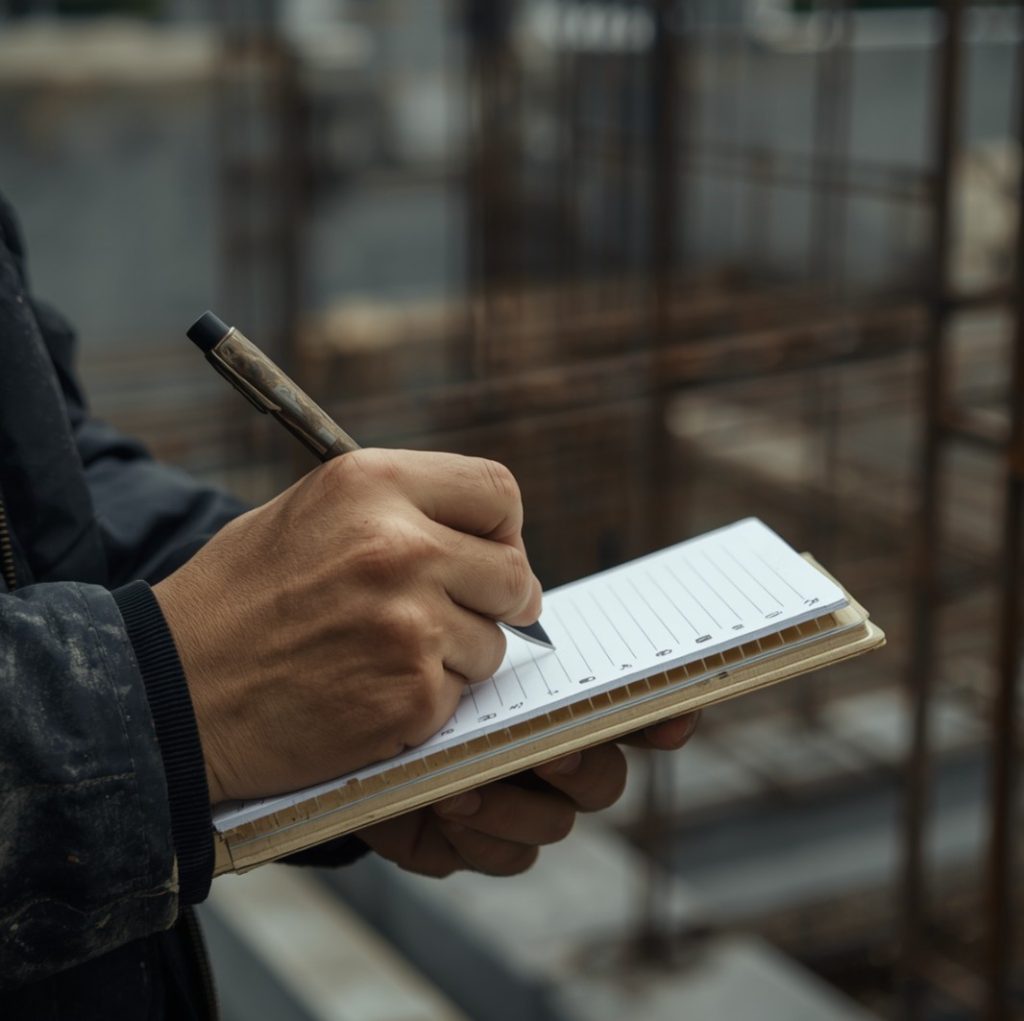
RForm is a responsive web application that enables architects to capture observations, photos, and notes directly on-site in real time, ensuring every detail is recorded with precision before memory has a chance to distort it.
2. Inconsistency Is a Liability You’re Handing to the Other Side
Every firm develops its own reporting habits. The problem is that habits aren’t standards, and in litigation, the difference matters enormously.
When reports vary in structure from team member to team member, critical observations are easy to miss, easy to misread, and easy to dismiss. Ambiguity in a construction document isn’t just an administrative annoyance; it’s an opening that experienced claims counsel knows how to exploit.
A standardized reporting framework closes that opening. When every report, regardless of who wrote it, which project it covers, or how complex the site visit was, follows the same professional structure, you’re not just maintaining brand consistency. You’re creating a body of documentation that is difficult to challenge and difficult to ignore. Disciplined records signal disciplined practice. That alone can discourage disputes before they begin.
RForm enforces a consistent, professional report structure across every team member and every project, eliminating the ambiguity that gives opposing counsel room to work.
3. An Untracked Deficiency Is an Unsolved Problem
Construction projects have a well-known pathology: an issue gets flagged in a site report, acknowledged in the moment, and then quietly disappears. No one follows up. No one verifies it was resolved. Months later, it resurfaces, bigger, more expensive, and harder to attribute.
This happens when site reports function as static snapshots rather than a living project record. A PDF filed and forgotten is not a risk management tool. It’s a paper trail with gaps.
Effective reporting carries unresolved items forward, automatically, visit after visit, until they’re addressed and verified. The issue doesn’t disappear from the record just because it wasn’t resolved. It persists, visibly, in every subsequent report, creating accountability without requiring anyone to remember to follow up. The project’s full history is always present, always current, and always accessible.
RForm automatically carries unresolved deficiencies forward into every subsequent report, maintaining a continuous, visible record until each issue is fully closed.
4. Administrative Overhead Is Billable Time You’re Giving Away
Consider what it actually costs your firm each week: manually re-entering data from the previous visit. Resizing and placing photos. Re-formatting headers. Rebuilding context that already exists somewhere in a previous report.
This is the hidden tax of poor tooling, and it compounds. Across a project team over the life of a complex engagement, the hours lost to document production are significant. More importantly, they’re hours that should be spent on site integrity, design quality, and client relationships.
A purpose-built reporting workflow eliminates the blank-slate problem. You build each report on the foundation of the last one, pulling forward observations, carrying open items, retaining structure, so the time spent on documentation shrinks as the project grows. What remains is the work only you can do.
RForm lets you pull data, and open items forward from previous reports with a single action, cutting document production time dramatically and freeing your team for higher-value work.
The Bottom Line
Your site reports outlive the project. They get read by lawyers, reviewed by insurers, and scrutinized by people who weren’t there. What they find in those documents or what they don’t find, will determine whether your firm is protected or exposed.
The tools you use to produce those reports are not just a back-office detail—they are a professional and legal decision. RForm ensures you make the right one.