

RForm CA Masterclass · Part 7
Stop the Scope Creep:
How to Turn Construction Cash Allowances from Liabilities into Assets

For construction professionals, few project milestones trigger as much anxiety as reconciling a ‘cash allowance’. Intended to be a practical tool for managing costs on items not yet fully designed or specified, allowances too often evolve into sources of scope creep, budget disputes, and administrative headaches that can quietly derail even the best-planned projects.
The frustrating irony is that cash allowances exist to add flexibility, to give owners and architects room to finalize decisions without stalling a project. Yet without the right systems in place, that flexibility becomes a liability. Understanding why allowances go wrong, and what a structured approach looks like, is the first step toward putting them back to work for you.
What Is a Cash Allowance and Why Does It Matter?
A cash allowance is a predetermined sum included in a contract to cover the cost of a specific item or scope of work that has not yet been fully defined at the time of bidding. Common examples include finish fixtures like light fittings or plumbing hardware, specialty equipment awaiting final selection, and exterior landscaping elements still under design.
The allowance acts as a placeholder: the owner agrees to a budget, and the contractor agrees to execute whatever falls within it. If the final selection costs more, a change order is issued. If it costs less, the savings flow back to the owner. In theory, it is a clean and equitable mechanism. In practice, the gap between “in theory” and “in practice” is where projects lose money.
For example, an owner might select a lobby chandelier that technically comes in under the allowance budget. However, if that specific fixture requires unexpected structural reinforcement, resolving whether those installation costs are included in the allowance can quickly pause drywalling and reschedule trades. By using a clear, digital system to track and clarify these details upfront, you can instantly align expectations—keeping the project moving smoothly, the client happy, and your profit margins fully protected.
The Hidden Costs of Traditional Management
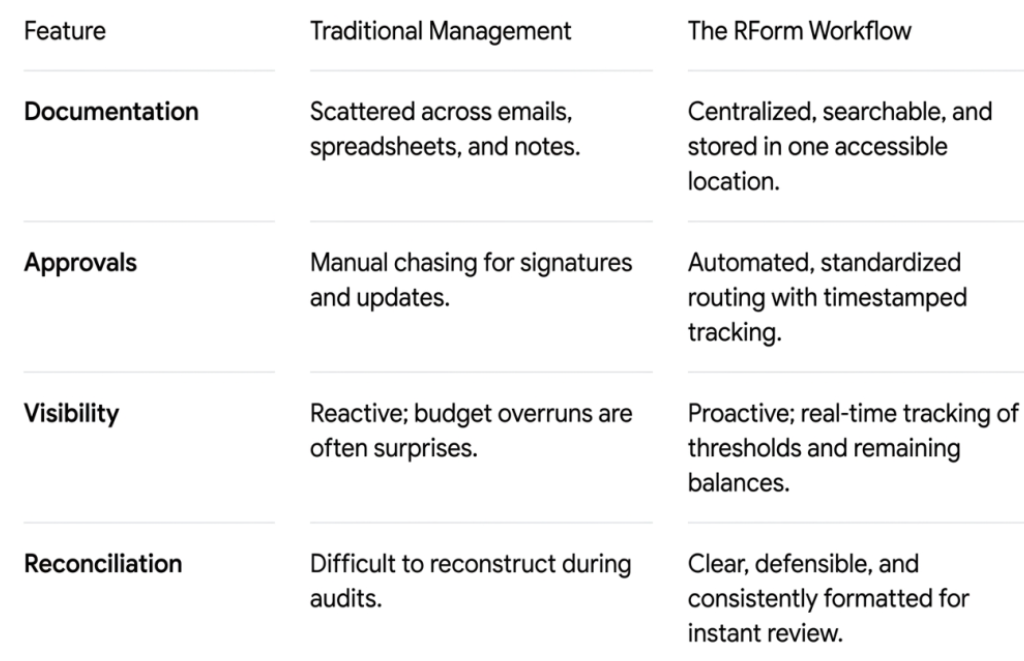
In many firms, allowances are tracked through a chaotic tangle of emails, sticky notes, and disconnected spreadsheets. This manual approach leaves every project vulnerable to several compounding risks.
Scope Ambiguity
Clearly defining exactly what an allowance covers upfront—such as specifying whether it includes labor and installation or just the base cost of the fixture—ensures that expectations between the owner and the contractor remain perfectly aligned. Establishing this clarity early on builds a strong foundation of trust that carries through the entire project. As a result, when you reach the fast-paced final stages of the build, approvals are handled smoothly, collaboratively, and without unnecessary stress.
Budget Blindsiding
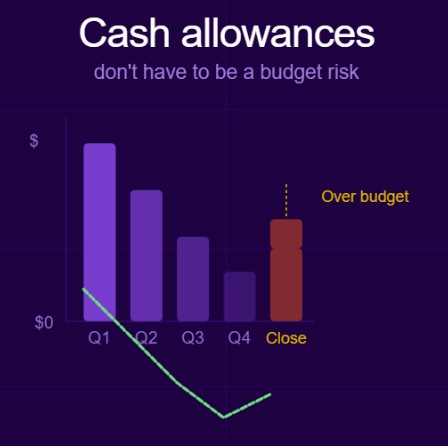
Without real-time tracking, stakeholders are frequently shocked when an allowance is exhausted without warning. Worse, they face payment shocks at project close when the final bill exceeds the original placeholder by an amount large enough to disrupt cash flow, and too late to adjust the project scope in response. A well-managed allowance gives everyone a running balance; a poorly managed one delivers a surprise invoice.
The Administrative Burden
Manually tracking quotes, issuing requests for quotation (CARQs), chasing approvals, and processing Cash Allowance Authorizations (CAAs) for dozens of line items consumes hours of project management time every week. That administrative drag compounds: delayed approvals slow procurement, which delays trades, which delays completion. The paperwork cost is not just the time spent on it, it is the schedule slippage that follows from doing it slowly.
The Documentation Gap
Perhaps the most underappreciated risk is the documentation gap that accumulates over a long project. When allowance decisions are made verbally or via informal email threads, there is no centralized record to consult when a dispute arises and disputes almost always arise. Reconstructing a decision-making trail from scattered inboxes and notebook entries is expensive, time-consuming, and rarely conclusive.
The RForm Solution: Turning Allowances into Assets
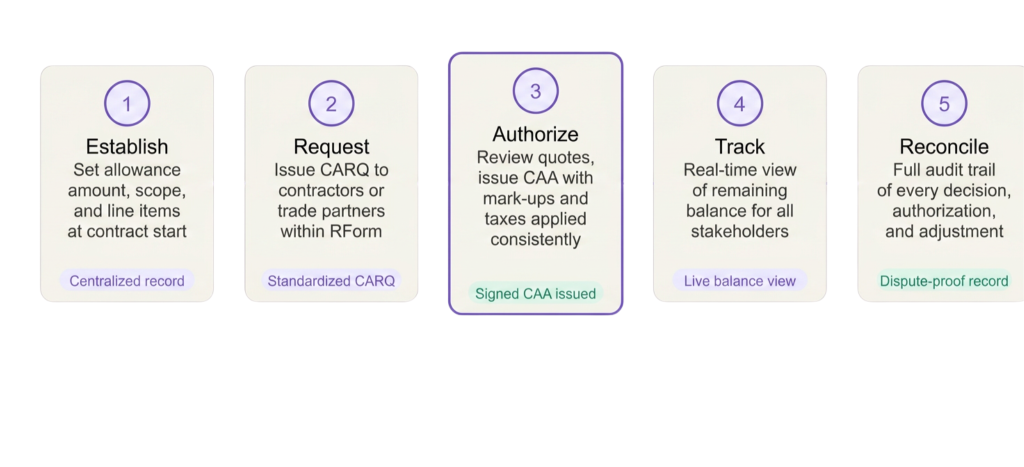
Technology is the most reliable antidote to allowance chaos. Contract administration software like RForm is designed specifically to bring structure, transparency, and automated tracking to these complex financial components ensuring every dollar is accounted for from the moment an allowance is established to the moment it is reconciled.
How RForm Transforms Your Daily Workflow
Centralized Documentation
RForm stores all allowance details, project-specific quotes, and signed authorizations in one central, accessible location. When a question arises six months into construction about what was approved and when, the answer is a search away not buried in someone’s email archive. This eliminates the “lost email” syndrome that frequently causes confusion during the reconciliation phase.
Automated, Standardized Workflows
From the initial CARQ to the final CAA, RForm guides all project stakeholders through a standardized approval chain. Every step, submitting a quote, reviewing it, issuing an authorization, acknowledging receipt, is tracked, timestamped, and visible to the relevant parties. By ensuring that no step in the approval process is missed or bypassed, RForm maintains professional accountability between all parties without requiring anyone to manually chase signatures.
Real-Time Financial Visibility
With RForm’s integrated reporting tools, stakeholders can see exactly how much of each allowance remains at any given moment. Project managers can easily view approaching thresholds before they are breached, giving owners and architects the opportunity to adjust scope or expectations proactively, rather than reactively, after the fact. This transparency prevents end-of-project payment shocks and supports more confident, informed decision-making throughout construction.
Clear Reconciliation
By standardizing the way mark-ups, overhead, and taxes are applied to allowance items, RForm ensures the financial relationship between the owner, contractor, and trade partners remains transparent and easily defensible. When an auditor or legal counsel needs to reconstruct the financial history of a project, every authorization and adjustment is documented in a consistent, readable format.
Cross-Feature Integration
Because site reports, RFIs, and change orders all live within the same RForm ecosystem, allowance decisions do not exist in isolation. A site report observation that triggers an allowance adjustment can be referenced directly to the resulting authorization, creating a complete, traceable record that connects field conditions to financial outcomes. This integration is what elevates RForm from a documentation tool into a genuine project management asset.
A Practical Example: Allowances Done Right
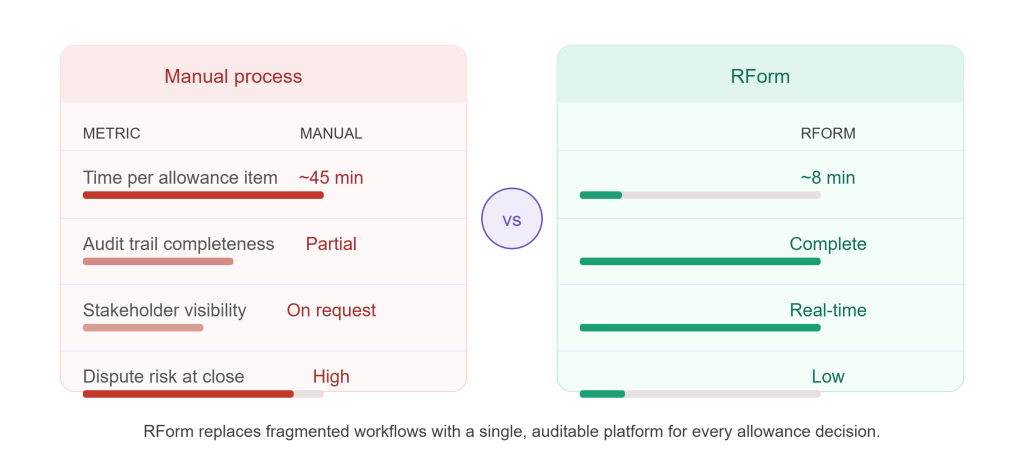
Consider a mid-rise residential project with 14 separate allowances covering fixtures, finishes, and specialty equipment. Under a traditional manual workflow, the project manager is responsible for tracking each one individually, maintaining a spreadsheet, coordinating approvals via email, and periodically updating the owner on remaining balances. Over a 20-month construction period, that is hundreds of individual touchpoints across 14 parallel threads.
Under an RForm workflow, each allowance is established as a line item at project outset. Quotes are submitted, reviewed, and authorized within the platform. The owner can log in at any point and see the status of every allowance: how much has been authorized, how much remains, and what is pending. When the glazing allowance runs short because the owner upgraded to triple-glazed units, the change order is generated within the same system and linked to the original allowance record. The audit trail is complete, automatic, and requires no extra effort from the project team.
The result is not just better documentation, it is a project team that spends less time on administration and more time on the work that actually requires human judgment.
Why Now Is the Time to Go Digital
The construction industry is moving faster than ever, creating incredible opportunities for firms that embrace streamlined workflows. Today’s owners are highly sophisticated and deeply engaged in their projects. By providing them with clear, accurate, and accessible documentation, you build lasting client trust and elevate the entire building experience.
Cash allowances are designed to be a powerful asset: a tool that facilitates design flexibility while keeping financial accountability perfectly intact. Bridging the gap between that ideal vision and daily execution is simply a matter of having the right system in place. When you upgrade your management tools, you unlock the true potential of allowances, letting them work for you rather than against you.
By transitioning from manual processes to an integrated digital platform like RForm, construction professionals can reclaim hours of administrative time each week, foster proactive collaboration, and ensure that project budgets remain confidently under control from the first site visit to the final inspection. Optimizing these workflows doesn’t just maximize your profit margins—it gives your team a distinct competitive advantage and makes every project a more rewarding experience.
Are you still tracking allowances in a spreadsheet? It might be time to see what a purpose-built contract administration platform can do for your projects.
RForm is contract administration software designed for architects, engineers, and construction professionals, built to streamline documentation, financial tracking, and team collaboration from a single platform.