
RForm CA Masterclass · Part 8
The Power of Precision:
How Clarifying Contract vs. Construction Administration Builds Stronger Architect-GC Partnerships

Good fences make good neighbors, and clear terminology makes for highly successful project teams. Two of the most frequently confused terms in our industry, “Contract Administration” and “Construction Administration,” sound nearly identical but describe fundamentally different roles. When that ambiguity goes unaddressed, teams end up second-guessing each other, communication slows down, and friction creeps into what should be a straightforward working relationship.
Eliminate the ambiguity, though, and something changes. Architects, engineers, and general contractors stop stepping on each other’s toes and start doing exactly what they each do best. That’s not a legal technicality, it’s the foundation of a genuinely cooperative project.
Shared Language for Shared Success
The AIA and CCDC definitions of Contract Administration and Construction Administration aren’t just legal boilerplate to skim past during contract review. Read the right way, they’re a framework for collaboration.
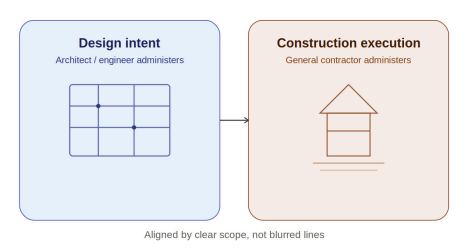
In simple terms: the design team administers the contract documents, ensuring the built project reflects the design intent captured in the drawings and specifications. The general contractor administers the physical construction, managing the means, methods, sequencing, and day-to-day execution required to actually build the thing. One side owns the “what” and “why.” The other owns the “how.”
When every party on a project understands this distinction from day one, expectations are set before a single wall goes up. Nobody wonders whether a question belongs on the architect’s desk or the superintendent’s. That clarity alone removes a surprising amount of friction from a project’s daily rhythm.
Empowering the GC’s Expertise
When architects consciously step back from dictating means, methods, and sequencing, it’s easy to frame that as pure risk management, staying out of territory that isn’t covered by professional liability insurance. And that’s part of it. But there’s a more constructive way to see it: stepping back is also an act of respect for the GC’s operational expertise.
General contractors are the specialists in how a building actually comes together, the logistics, the trade coordination, the site-specific problem solving that no set of drawings can fully anticipate. Giving GCs the room to apply that expertise, without a design team second-guessing execution decisions, lets them innovate and solve problems efficiently. It’s not a boundary drawn out of caution. It’s a boundary drawn out of trust.
Frictionless RFIs and Submittals
This is where the distinction stops being theoretical and starts showing up in the daily workflow. When the design team focuses purely on interpreting design intent, the “what”, and leaves the “how” to the contractor, RFIs and submittal reviews get faster, sharper, and far more actionable.
An RFI that clearly separates a design-intent question from a means-and-methods question gets routed correctly the first time. A submittal review that stays focused on conformance with the contract documents, rather than drifting into construction sequencing commentary, moves through the review cycle without unnecessary back-and-forth. Multiply that efficiency across dozens of RFIs and hundreds of submittals over the life of a project, and the cumulative time savings are significant.
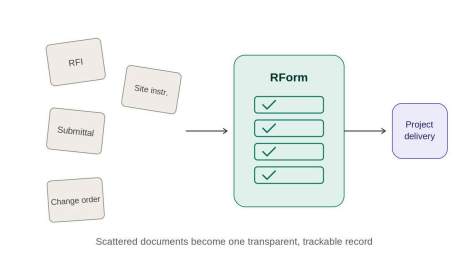
This is exactly the kind of workflow RForm was built to support. RForm gives design teams and contractors a shared, structured environment for tracking RFIs, submittals, Change Orders, and Site Instructions, so every request lands with the right party, in the right format, with full visibility
into status and history. Instead of digging through email threads to figure out who owns a question, everyone can see it in one place, correctly categorized from the start.
Mutual Risk Reduction
Clear boundaries don’t just speed up communication, they reduce risk for everyone on the team. When liability sits clearly with the party best equipped to manage it, insurance policies function the way they’re designed to. Professional liability coverage protects design intent; the GC’s coverage protects execution. There’s no gray area for a claim to fall through, and less incentive for finger-pointing when something goes wrong.
That risk clarity has a cultural effect, too. When responsibility is well-defined, teams stop operating defensively and start operating as true partners aligned toward the same goal: delivering the project. Disputes that might otherwise escalate get resolved faster because the documentation trail makes the division of responsibility obvious.
A platform like RForm reinforces this naturally. Because every Change Order, Site Instruction, RFI, and submittal is logged, timestamped, and tied to the responsible party, the record of who decided what, and when, is never in question. That transparency doesn’t just protect each party if a dispute arises; it actively discourages disputes from forming in the first place, because everyone is working from the same documented reality.
Align Your Team Before the Shovel Hits the Dirt
Precision in terminology is a small thing that produces an outsized result: teams that trust each other’s roles, communicate efficiently, and manage risk as partners rather than adversaries. Share this article at your next project kickoff meeting, and use it as a starting point for a conversation about how your team defines these roles.
Then give that clarity a place to live throughout the project. RForm’s collaborative construction administration environment keeps design intent and construction execution organized, transparent, and moving forward,so the boundary you set at kickoff stays intact all the way through closeout.