
RForm Master Class : Part 6 of 6
The Critical Link:
How Submittals and Schedule Protection
Shape Canadian Construction Projects

In the Canadian construction landscape, a project’s success is often decided long before the first shovel hits the ground or the last nail is driven. While much attention is placed on the physical build, the administrative backbone, specifically the submittal process, serves as the primary mechanism for quality control, design intent, and, crucially, schedule protection.
For architects, engineers, contractors, and owners, navigating the complexities of contract administration requires more than diligence. It requires a system that ensures nothing falls through the cracks, and that every approval, rejection, and resubmission is traceable back to a specific date, a specific person, and a specific version of a document.
Why Submittals Are More Than Just “Paperwork”
Submittals are the bridge between design intent and physical reality. Whether they are shop drawings, product data sheets, samples, or mock-ups, they are the contractor’s formal declaration of how they intend to meet the requirements of the construction contract. They give the design team the opportunity to verify compliance with specifications before materials are ordered, fabricated, or installed, not after.
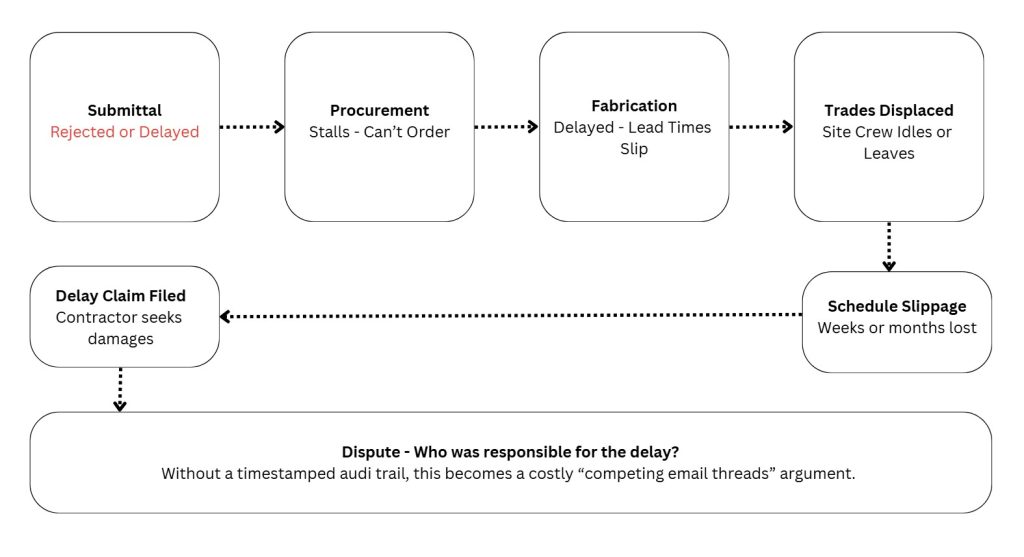
In Canada, where construction projects often involve complex regulatory requirements, long procurement lead times, and multi-layered subcontracting structures, a poorly managed submittal process can become a silent killer of project timelines. If a submittal is rejected, delayed, or lost in an email chain, the associated procurement and installation work stalls. That stall creates a domino effect, a delayed structural steel shop drawing holds up fabrication, which holds up erection, which holds up the mechanical trades waiting to rough in above the deck. The schedule impact of a single missed submittal can ripple for months.
What makes this risk particularly acute is that the submittal process is ongoing. It does not conclude at mobilization or when the structural frame is up. Submittals continue through to project closeout, operating manuals, maintenance data, warranties, and as-built documentation all require formal review and acceptance before final payment can be certified. A firm that manages submittals reactively, by email and spreadsheet, accumulates administrative debt throughout the project that compounds at exactly the moment the team is most fatigued: the final push to substantial completion.
One Missed Submittal – Five Consequences
How a single administrative failure cascades across a project schedule.
The Relationship Between Submittals and Schedule Protection
Schedule protection is not simply about having a high-level Gantt chart on the wall. It is about actively shielding the critical path from avoidable administrative delays, and recognizing that administrative failures are just as capable of derailing a schedule as weather, labour shortages, or supply chain disruptions.
Proactive validation before procurement
Submittals act as a critical checkpoint that moves quality control upstream. By verifying that materials and systems meet specifications before they are ordered or installed, teams prevent costly rework that could push back completion dates by weeks or even months. A rejected shop drawing caught in the review cycle costs a phone call and a resubmission. The same error caught during installation costs time, money, and the contractor’s credibility with the owner.
Aligning the submittal schedule with procurement lead times
The project schedule should dictate the flow of submittals, not the other way around. When contracts clearly define submission deadlines that align with material procurement lead times, especially for long-lead items like elevators, curtain wall systems, or custom millwork, stakeholders can track performance against a plan and identify potential bottlenecks early, while there is still time to recover. In practice, this means the submittal schedule needs to be built into the construction schedule from day one, not developed as a separate document that lives in a different binder.
The risk of the paper trail gap
Relying on manual spreadsheets or disconnected email threads is a significant vulnerability in Canadian project delivery. If a document is misfiled, an approval is buried in an inbox, or a resubmittal arrives without clearly flagging what changed from the previous version, the clock on the project schedule continues to run. By the time the gap is discovered, the delay has already occurred, and the question of who is responsible for it becomes the subject of a formal claim. Under standard Canadian contract forms such as CCDC 2, both the contractor’s obligation to submit on time and the design professional’s obligation to respond within a reasonable period are contractual duties. When neither party has a clean record of what was sent, when it was received, and how long review actually took, the dispute becomes a battle of competing email threads, expensive to resolve and rarely satisfying for either side.
Version control as a schedule tool
Confusion over which drawing or product specification is the current, approved version is one of the most underappreciated sources of rework in construction. A subcontractor who orders material from an unapproved or superseded submittal, or who misses a conditional “approved as noted” comment, can create a field problem that requires demolition and reinstallation. That is not a construction error in the traditional sense, it is an information management failure, and it is entirely preventable.
The Liability Dimension: What Canadian Design Professionals Need to Know
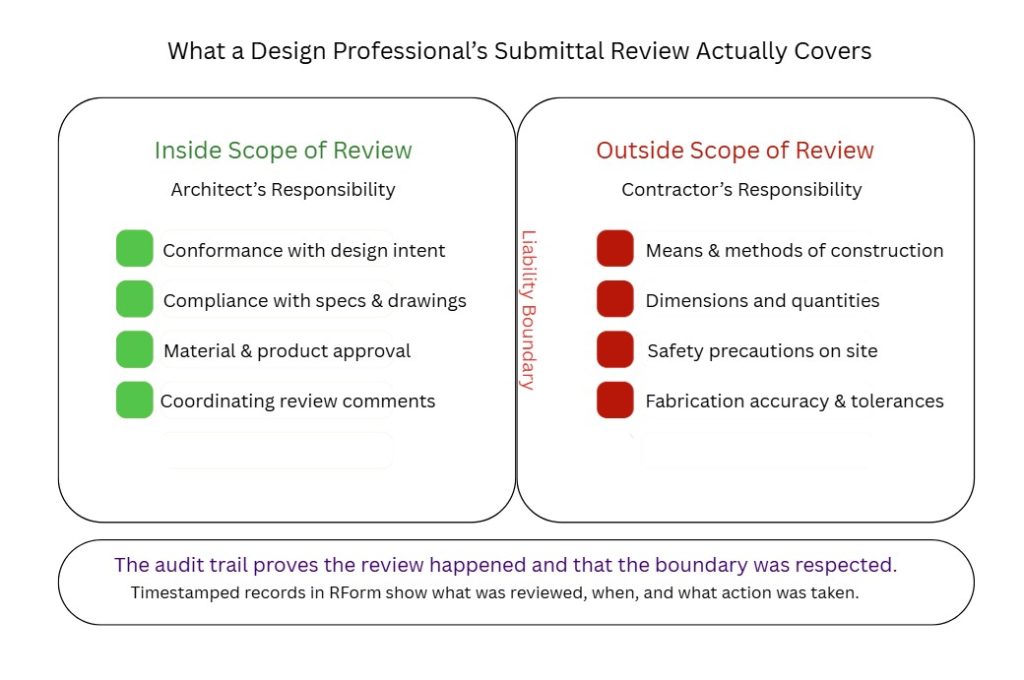
Beyond schedule risk, the submittal process carries meaningful professional liability implications for architects and engineers practising in Canada. The design professional’s role in reviewing submittals is defined and limited by the contract, typically, review is for conformance with design intent, not for verifying the contractor’s means and methods, dimensions, or quantities. That boundary matters, and it needs to be documented clearly.
Under RAIC guidelines and standard practice, a design professional who approves a non-conforming submittal, fails to respond within a reasonable period, or cannot demonstrate that they actually reviewed what was submitted faces potential exposure in the event of a defect claim or delay dispute. The consequences range from professional reputation damage to licence proceedings to civil liability. A robust, timestamped submittal record is not just a project management convenience, it is a professional liability defence.
This is why the phrase “defensible project record” has taken on real weight in Canadian construction law. The question is not just whether the right decision was made, but whether the record can prove it.
Modernizing Contract Administration with RForm
To protect the project schedule and manage professional risk, you need a system that provides visibility, accountability, and a permanent audit trail. This is where RForm plays a pivotal role in the Canadian construction sector.
RForm is a cloud-based contract administration platform designed specifically to manage the complexities of construction workflows, including submittals, RFIs, change orders, site reports, and project files. It is built around the way Canadian architects, engineers, and contractors actually work, not around a generic project management template adapted from another industry.
Eliminating administrative bottlenecks
RForm keeps all communication and documentation within one centralized, cloud-based platform. Project leads can see in real time exactly where a submittal sits in the review cycle, submitted, under review, returned for correction, or approved. This transparency prevents the lost document scenario that frequently causes delays, and it eliminates the need for follow-up emails and status calls that consume hours of project management time each week.
Enforcing the submittal schedule
RForm ties submittal tracking directly to the project timeline. When a submittal is approaching its required response date, the platform surfaces that visibility automatically, so teams can act before a deadline is missed, not after. This proactive structure replaces the reactive scramble that characterizes email-based submittal management.
Ensuring version control
RForm’s version control ensures that all stakeholders, from subcontractors to consulting engineers to the prime consultant’s office, are always working from the most recent, approved documents. When a resubmission arrives, it is clearly linked to the original submittal and any previous revisions, with changes flagged for the reviewer’s attention. There is no ambiguity about which version governs.
Creating an unalterable audit trail
In the event of a delay claim or defect dispute, having a verifiable, unalterable record is essential for protecting your interests. RForm ensures that once a document is finalized, it cannot be deleted or modified, providing a defensible project record that aligns with the documentation standards expected under Canadian contract forms, including CCDC 2 and CCDC 5B. This is the kind of record that resolves disputes quickly, because the facts are not in question.
Role-based access and collaboration
RForm allows project leads to manage permissions effectively, ensuring that team members have access to the information they need without exposing sensitive internal data. Contractors see what they need to submit and track. Consultants see what requires their review. Owners see the status of the project without being buried in technical detail. This structured collaboration replaces the ad hoc email chain that leaks information to the wrong parties and loses it from the right ones.
What Good Submittal Management Looks Like in Practice
Consider a mid-size institutional project in Ontario, a school addition, say, or a community health centre. The project has 60 to 80 distinct submittal items across structural, mechanical, electrical, and architectural scopes. Under a manual workflow, the prime consultant maintains a spreadsheet that someone updates when they remember to. Submittals arrive as email attachments with inconsistent naming conventions. The review queue grows during busy periods and gets cleared in bursts, creating unpredictable turnaround times that the contractor cannot plan around.
Under an RForm workflow, every submittal is logged at receipt with a timestamp. The review deadline is set automatically. The consultant’s team can see the full queue at a glance, prioritize by urgency and lead time, and return reviewed submittals through the platform with comments attached directly to the document. The contractor sees the approval in real time, can pull the approved version immediately, and has a clear record if a dispute arises later about when the approval was given.
The difference is not just efficiency, it is a fundamentally different risk profile for every party on the project.
Conclusion
In the fast-paced world of Canadian construction, submittals are the lifeblood of contract administration. When managed effectively, they provide the assurance that the project is being built to plan, on time, and on budget, and the documentation to prove it if that is ever challenged. When managed poorly, they become the source of exactly the delays, rework, and disputes that every project team is trying to avoid.
By moving away from fragmented, manual processes and adopting a dedicated platform like RForm, Canadian project teams can turn their administrative process into a genuine competitive advantage: faster decisions, cleaner records, and a schedule that is protected by design rather than by luck.
Is your firm still managing submittals through spreadsheets and email threads? RForm offers a free first project with no credit card required, a low-risk way to see what structured contract administration feels like on a real job.