

The Burden of Administrative Debt
In the modern architectural practice, the complexity of project delivery is often throttled by antiquated administrative workflows. While Building Information Modeling (BIM) has revolutionized design, the “Contractual Interface”—the management of RFIs, Change Orders, and Progress Claims—often remains tethered to fragmented spreadsheets and disparate email chains. This creates “administrative debt”: a compounding risk of math errors, lost documentation, and delayed certifications that can threaten an Architect’s professional standard of care.

Restoring the Continuity of Information
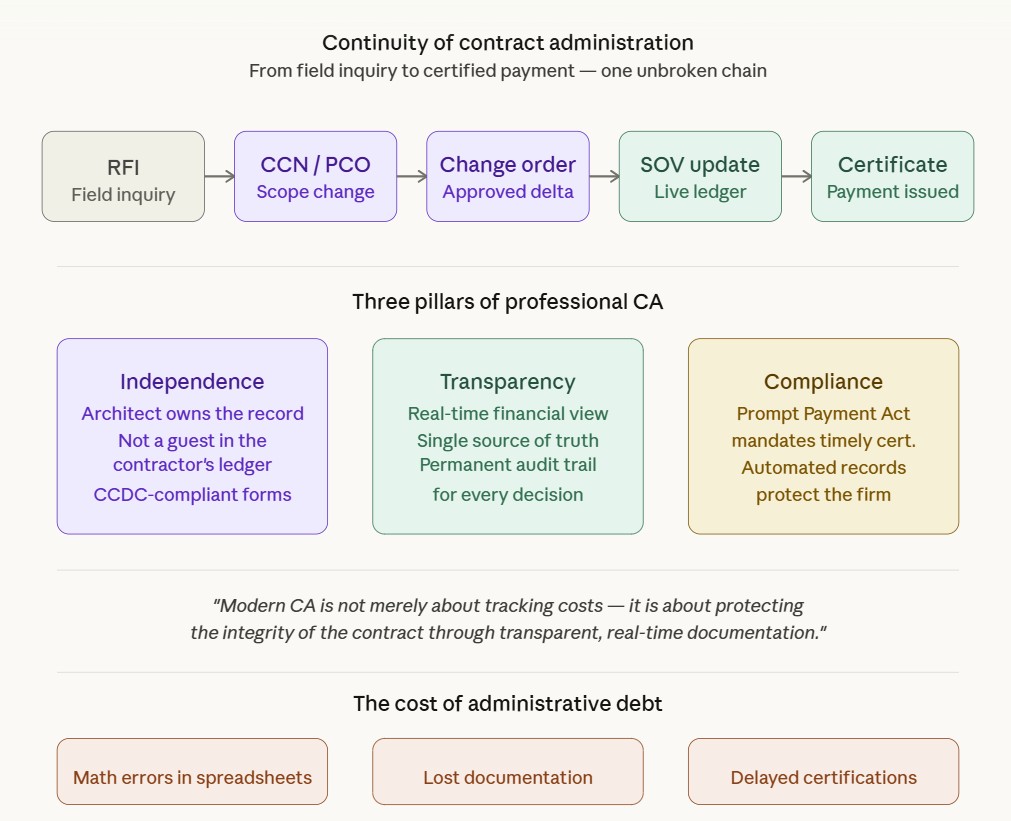
Professional excellence in Contract Administration (CA) requires a seamless “Chain of Custody” for every project decision. When the flow of information is fragmented, the Architect’s role as the Independent Certifier is compromised. To maintain project velocity without sacrificing accuracy, the transition from field inquiry to financial adjustment must be a continuous, automated loop:
- Integrated Change Management: A professional CA workflow ensures that a Request for Information (RFI) that impacts scope is immediately transitioned into a Contemplated Change Notice (CCN) or Proposed Change Order (PCO). This eliminates the “transcription gap” where errors most frequently occur.
- The Synchronized Ledger: The integrity of the Schedule of Values (SOV) is the foundation of the Certificate for Payment. By utilizing a system where an approved Change Order automatically updates the SOV in real-time, the Architect ensures that every certification is based on a single, verified version of the truth.
- Statutory Compliance & Prompt Payment: With the rollout of Prompt Payment legislation across Canada, the Architect’s timeline for certification is now legally mandated. Automating the recording process is no longer just about efficiency—it is about meeting statutory obligations and protecting the firm from “Notice of Non-Payment” disputes.
“Modern Contract Administration is not merely about tracking costs; it is about protecting the integrity of the Contract through transparent, real-time documentation.”
The Architect as the Independent Certifier
There is a growing trend of General Contractors inviting Architects into their proprietary production software. While collaboration is essential, the Architect must maintain an independent, neutral record of the contract. Utilizing a dedicated CA platform like RForm allows the Architect to:
- Maintain Professional Independence: Avoid being a “guest” in the Contractor’s ledger.
- Ensure CCDC Compliance: Maintain the formal structure and language required by standard contract forms.
- Provide Owner Value: Offer the client a “Financial Birth Certificate” of the project—a clean, audited, and tamper-proof record of every dollar spent.
Conclusion: Leading the Project, Not Just the Design
The evolution of the profession requires that we apply the same level of digital rigor to our Contract Administration as we do to our Design Development. By streamlining the path from RFI to Certification, we reduce administrative friction, protect our professional liability, and ensure that our focus remains where it belongs: on the built environment.